I watched – a bit late – La Grazia by Paolo Sorrentino and found it a magnificent film.
A journey through the labyrinths of law – both formal and substantial –, power, and old age, and thus, life itself.

From the title and synopsis, one might have expected a political film in the classical sense. Yet, beyond the presidential dimension, we find almost exclusively the story of a man of power in his palace, grappling with the human side he has barricaded himself behind for a lifetime, ready to melt like ice cream when his existence and circumstances finally place him at a decisive crossroads.
The President of the Republic and mythic iron-willed jurist, “Reinforced Concrete,” longtime Christian Democratic politician Mariano De Santis, faces, in the last six months of his term, two requests for pardon and the signing of the euthanasia law – a scenario that could even place the film in the science fiction genre, or at least in the realm of “fantapolitics.”
Sorrentino naturally does not mention specific names, but the inspiration from two Presidents is evident to almost everyone. For me, there is much of Scalfaro and Mattarella in this film.

The film opens with a list of the prerogatives of the Italian Head of State against the backdrop of the sky over the Quirinal Palace, citing the Constitution article by article, just as at the beginning of Il Divo he had summarized decades of Italian politics to the world. In this way, the film also acquires a didactic dimension, simulating the daily life of a king without a crown: between the solitude and prudence necessary to survive such a role – with the constant breath of public opinion on his neck – and human relationships with collaborators, friends, and leading politicians, including his daughter – also a jurist – played by Anna Ferzetti.
This is all the institutional politics we see. Everything else is living politics, centered on a jurist in the final stage of his life, hollowed out by the loss of his wife, whose betrayal thirty years earlier he has not yet come to terms with, and who must essentially confront the question his daughter asks him: “To whom do our days belong?”
And, above all, whether he is capable of answering it by the end of his term without “destroying” himself too much.

Paolo Sorrentino – on this occasion – revisits his own Youth and carries it through to its full conclusion.
Where that film — which I did appreciate at the time — remained somewhat on the surface, losing itself in its now proverbial formal baroque flourishes and assorted eccentricities that occasionally verged on self-parody, here I found everything considerably scaled back — in what I see as a maturation, or a rediscovered artistic flexibility — placed at the service of an extraordinarily well-written human tragedy disguised as a political drama.
Toni Servillo is “terrifying” in his credibility, possessed of a profoundly moving truthfulness.
Probably, together with the younger Elio Germano and Pierfrancesco Favino, he is the finest — and certainly the most iconic — contemporary Italian actor. A performance that would not look out of place among the American Oscar nominees; and indeed, the Volpi Cup in Venice came rather easily.

The relative stretching of time and the focused editing immerse us in this metamorphosis, emphasized by a recurring electronic musical background, making the film feel vividly alive and never overly “embalmed.”
This is a work I consider to be of striking urgency and importance. If cinema still had the role it did a few decades ago, it would have sparked intense public debate – not just among cinephiles.
La Grazia can be summarized in one fundamental word – emphasized by the director himself: DOUBT.
Hoping not to spoil anything, the film “concludes,” but it does not provide clearly right or wrong solutions or choices.
What De Santis certainly discovers is that real life is too complex, multifaceted, humanly variable, and subjective to blindly hide behind principles considered universal – however deeply rooted or firmly believed in.
A reflection rarely – if ever – touches the majority of today’s politicians, and the general public only as cause-and-effect.
A hymn against dogmatism, whether it is the legal kind of “sticking to the books” or any other form.
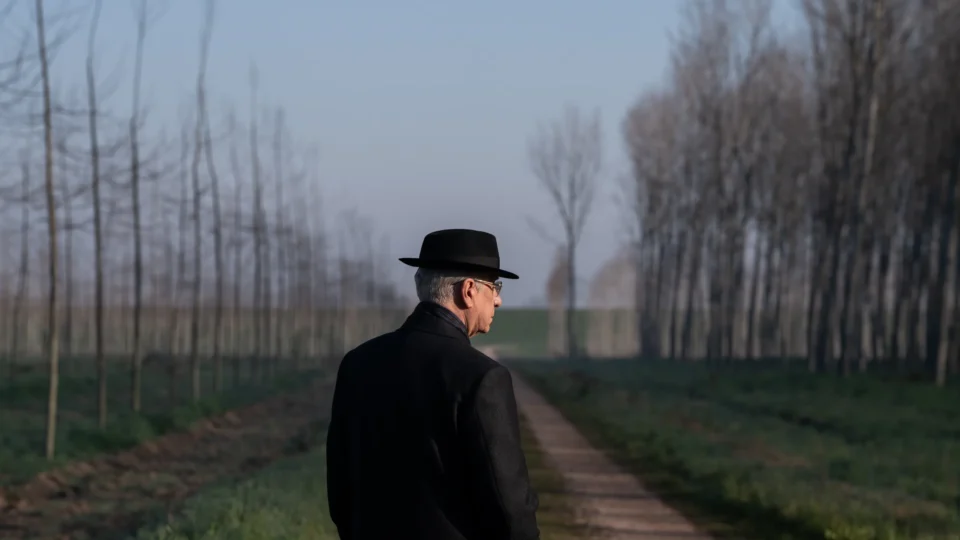
Sorrentino has always been European in content, Hollywood in form.
This hallmark is preserved here, but I see La Grazia – in his cinema – as the most contained and profoundly auteur-driven film of the past two decades. Already with The Hand of God, a somewhat “different” Sorrentino was glimpsed, but it was thought to be a one-off due to the autobiographical nature of that film; now we can perhaps assert with more certainty that a maturation or renewed flexibility in his filmmaking has occurred.
I find it a profoundly universal work, though likely not easily accessible to everyone today, when attention and reflection have become fleeting ideals.
It is not exactly a simple film, nor overly demanding, but it takes you by the hand without resorting to crassly commercial tricks.
Two things usually indicate to me how deeply a film has affected me and whether I will not forget it: losing the sense of time, and never once looking at the clock – even if in this case there was a personal “academic deformation” – and, at a certain moment, simply looking at a character’s face, understanding everything in an instant, and almost being moved. In this case, it happened with a man well into his seventies, if not older.
If these two things do not occur, it does not mean the film cannot still be unforgettable or magnificent; but if they do, it is a very important sign. It has happened with long films that comment for themselves: 2001: A Space Odyssey, Barry Lyndon, Rocco and His Brothers, Fanny and Alexander, Roma.
I fundamentally believe in the accessibility of films: that directors should find a key to speak to as many people as possible, otherwise their films – however beautiful – remain confined to festivals and hardcore cinephiles. Too often, Italian cinema suffers not from quality but from self-referentiality.
In the case of La Grazia, Sorrentino – who always conceives cinema as spectacle and is one of the few Italian directors to generate both box office success and public debate – could have pushed certain elements further, turning it into a “political thriller”…. Yet this would likely have distorted the entire poetics – the soul – of this film, which I hope and believe will grow in stature over time.
There are surprisingly evocative scenes, such as the slow-motion downpour that destroys all protocol during a State Visit while he stands impotent, witnessing the futility of formalities: a rainstorm on his own life.

The renewed – in Sorrentino’s recent cinema – dimension of this film also highlights his screenwriting, aside from occasional naïveté or abrupt jumps, often overshadowed by his reputation as a creator of striking visual quotations. This film gives him a kind of rehabilitation and a demonstration of strength even in this aspect.
Artistically, this is my take, but I also want to add some “industrial” reflections, which often determine a film’s fate.
One thing I’ve “concluded” is that Sorrentino seems rather incapable of understanding film marketing.
I suspect his Oscar owed much to Medusa, his former trusted producer Giuliano, and the global success of The Hand of God to Netflix.
I have been reflecting for months on what I consider a suicidal distribution strategy for this film.
Premiered in opening at Venice last September, it was then frozen for months, preventing it from competing – a nearly impossible feat this year – for Best International Film.
Meanwhile, in the U.S., it was released late last year via Mubi – a wonderful auteur cinema platform, but fairly limited, effectively burning the film through overly cautious choices.
I don’t think it can be easily recycled next year for the foreign film Oscar circuit; similar missteps have happened with other awards where it could have already competed.
It wouldn’t have been easy, and in hindsight, one might suspect they predicted it would not have much path in today’s climate.
It is not a film made for Anglo-Saxon awards – we have seen Panahi’s over-hyped film, Palme d’Or at Cannes, fail to make an impact at recent Oscars – nor for European ones. Launching it this way seems senseless.
A September 2025 release or Cannes 2026 premiere – an Italian submission – might have helped.
Otherwise, we are talking about a political film without being political – yet almost everything in it is, with apologies to the great Wim Wenders, in an age of encouraged indifference, sometimes even by artists themselves.
In any case, it is an absolute must-see for anyone interested in the interplay of personal life, law, and power, and in search of cinema of genuine value.
